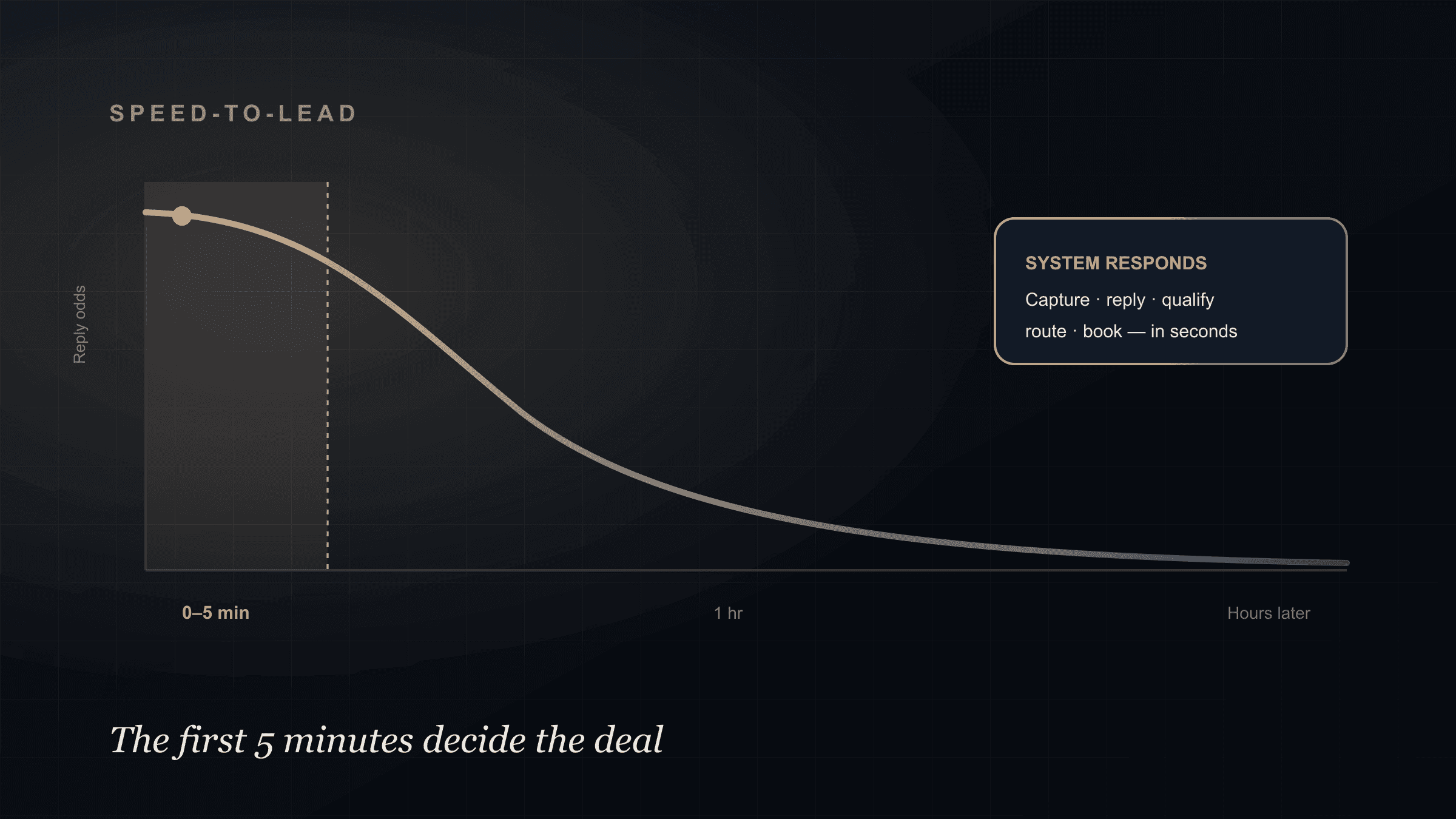
A lead who fills out your form is never more interested than in the ten seconds after they hit submit. Every minute after that, interest decays and the odds they answer a call or reply to a message drop.
This is speed-to-lead: the time between a lead arriving and a real, relevant response reaching them. It is one of the few growth levers that costs nothing in ad spend and still moves the number.
Most businesses know this and still respond in hours, because the response depends on a human noticing. The fix is not to tell your team to be faster. It is to build a system where the first response does not wait for a human at all.
What Speed-to-Lead Actually Means
Speed-to-lead is not "how fast does someone eventually reply." It is how fast the lead receives a response that acknowledges what they asked and moves them toward the next step.
That distinction matters. An automated "Thanks, we got your message" that fires in 30 seconds but says nothing specific is fast and useless. A tailored reply that references their inquiry, asks one qualifying question, and offers a booking link is fast and effective.
The target most high-performing teams aim for is a first meaningful response inside five minutes, and ideally inside one. The reason is simple: the lead is still on your site, still in the mindset that made them fill out the form, and still comparing you against whoever else they contacted.
Why the Window Closes So Fast
Three things happen in the minutes after a form submit.
First, attention moves on. The lead closes the tab, gets pulled into a meeting, or opens the next provider's site. The context that made them reach out fades.
Second, they contact competitors. A prospect shopping for a service rarely fills out one form. Whoever responds first with something useful sets the frame for the whole conversation.
Third, doubt creeps in. Silence reads as "they're not responsive" or "they're expensive and busy." A fast, specific reply reads as "these people are on it."
None of this is about being pushy. It is about meeting the lead while they still care.
Why "Just Respond Faster" Fails
Telling a sales team to respond within five minutes works until the first busy day. Then a rep is on a call, it's after hours, three leads land at once, or the notification gets buried.
Manual speed-to-lead depends on a human being available and attentive at the exact moment a lead arrives. That is not a system. It is a hope.
It also creates a hidden tax: reps context-switch to chase every new lead, which fragments their focus and still leaves gaps. The leads that arrive at 9pm or during a demo simply wait.
The businesses that win on speed do not have faster reps. They have a system that responds first and hands the rep a warm, qualified conversation instead of a cold form fill. This is the same shared-context principle behind avoiding fragmented GTM: the response should carry the lead's context, not restart from zero.
Engineering a Sub-5-Minute Response System
Here is the sequence that makes instant response reliable instead of heroic.
1. Capture the lead the instant it submits. The form writes directly into the CRM with source, campaign, page, and the message the lead typed. No inbox, no nightly sync, no manual entry.
2. Fire an instant acknowledgment. Within seconds, a personalized SMS, WhatsApp, or email goes out referencing what they asked, not a generic auto-reply. This alone puts you ahead of most competitors.
3. Qualify with AI, inside guardrails. An AI step reads the inquiry, classifies intent and urgency, and can ask one or two qualifying questions. It summarizes the exchange into a CRM note so the rep reads context, not a raw form dump.
4. Route to the right owner immediately. The lead lands in the correct pipeline stage with an owner assigned and an alert sent, so the human touch happens while the lead is still warm.
5. Offer booking at the peak moment. A booking link is presented right when interest is highest, turning a form fill into a scheduled conversation without back-and-forth.
6. Follow up automatically if they go quiet. If the lead doesn't book, a reminder sequence follows over the next few days, so a missed reply never means a lost lead.
Every step shares the same memory, so the acknowledgment, the CRM note, and the booking all reference the real inquiry. The rep inherits a qualified conversation instead of starting cold.
Where AI Fits, and Where It Doesn't
AI is what makes instant, relevant response possible at any hour. It should summarize the inquiry, classify urgency, draft the first message, ask qualification questions, and keep the CRM current.
What it should not do is freestyle with your leads unsupervised or invent facts. Sensitive actions stay previewed, approved, and logged. The AI accelerates and organizes the follow-up so your team spends its time on live conversations, not data entry. For the deeper build pattern behind a safe AI-in-the-loop workflow, see connecting Make, HubSpot, and Claude.
Measure It, Then Protect It
You cannot improve what you don't measure. Track median time-to-first-response, the percentage of leads answered within five minutes, and booked conversations by source. If those numbers are invisible today, that is the first thing to fix.
Want a quick sense of the cost? Our speed-to-lead calculator estimates the revenue slow follow-up is quietly leaking, and the funnel leak calculator shows where else leads fall out between the click and the booking.
Make Speed a System, Not a Scramble
Speed-to-lead is the cheapest conversion lever you have, but only if it runs on a system instead of on someone remembering to check an inbox.
Technovier builds that system: instant capture, AI-assisted response, routing, booking, and reporting, connected as one CRM AI automation engine. It also plugs the broader leaks covered in stop lead leakage after ads.
If your ad leads are waiting hours for a first reply, talk through speed-to-lead and we'll map the sub-5-minute version for your stack.
FAQ
What is a good speed-to-lead response time?
Aim for a first meaningful response within five minutes, ideally under one. The response should reference what the lead asked and move them toward a next step, not just confirm receipt. Response quality inside that window matters as much as raw speed.
Why does responding within 5 minutes matter so much?
In the first few minutes a lead is still on your site, still in the mindset that made them enquire, and still comparing you against competitors they also contacted. A fast, specific reply sets the frame for the conversation. After that window, attention moves on and reply rates drop sharply.
How do you respond to leads instantly without a rep watching the inbox?
Connect the form directly to the CRM, then fire an automated, personalized acknowledgment by SMS, WhatsApp, or email within seconds. An AI step qualifies and summarizes the inquiry, routes the lead to an owner, and offers a booking link, so the human touch happens on a warm, qualified conversation.
Does automated speed-to-lead replace the sales team?
No. It handles the instant acknowledgment, qualification, routing, and CRM notes so the sales team inherits a warm conversation instead of a cold form fill. Sensitive actions stay previewed and approved, and the human still runs the actual sales conversation.