Most founders do not have a lead problem. They have a context problem.
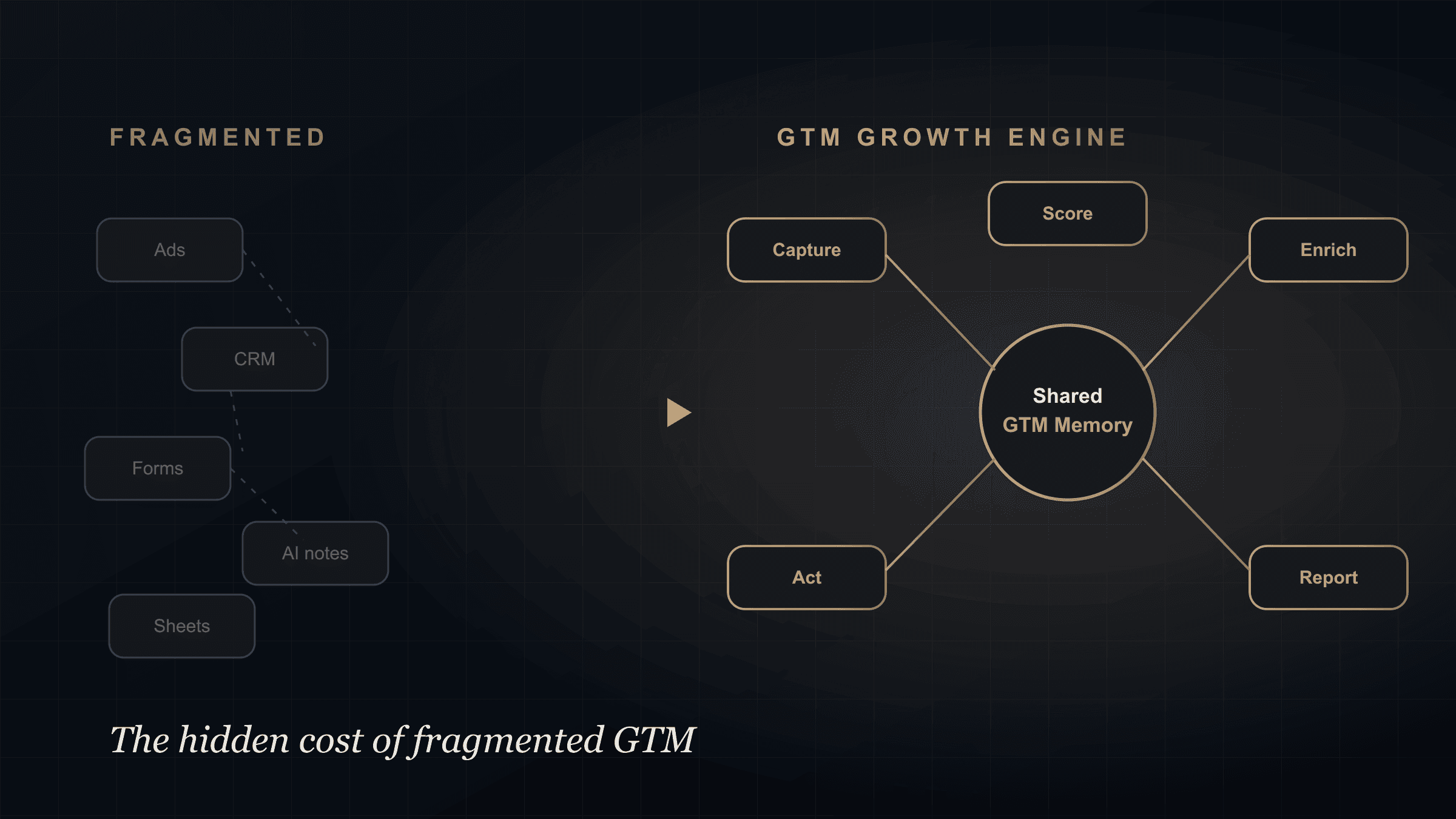
You are already running paid ads, LinkedIn outreach, a CRM, a few spreadsheets, an enrichment tool, and two or three AI writers. Every one of those tools works. None of them share what they know.
So a lead fills out a form on Tuesday, gets a generic reply on Thursday, and the sales rep opens the CRM on Friday with no idea the person already asked a specific question in the ad's chat widget. The context existed. It just never moved between systems.
That gap is where revenue leaks. Not in the ad account. In the handoffs between tools.
The Tool-Hopping Tax
Every disconnected tool adds a small tax. Individually the taxes look harmless. Stacked together, they quietly eat your pipeline.
Here is what the tax looks like in practice:
- A lead comes in through a paid ad, but the CRM only sees a name and email. The campaign, the ad, the page, and the question the lead typed are gone.
- An AI writer drafts a follow-up, but it has no memory of the last three touches, so the message repeats what was already said.
- An enrichment tool finds the company size and role, but that data lives in a separate dashboard the rep never opens.
- A rep copies a summary from ChatGPT into the CRM note field, then forgets to log the next action.
None of these is a disaster on its own. Together they mean your team is doing manual data entry between tools that were supposed to save time.
The result is inconsistent answers, duplicated work, and leads that go cold while everyone assumes someone else followed up.
More AI tools do not fix this. They add more places where context can get stranded. The fix is a system where every tool writes to and reads from the same revenue record.
Engineering a Unified Lead-to-Revenue System
A lead-to-revenue system treats ads, forms, CRM, AI outputs, follow-ups, and sales actions as one pipeline with shared context, instead of a stack of apps that email each other occasionally.
The system runs on shared revenue context: a single, structured record of who the lead is, what they did, what the AI concluded, and what should happen next. Every system reads from that record and writes back to it.
Here is the sequence that makes it work.
1. Real-time ingestion. The system captures intent signals the moment they happen: an ad form completion, an inbound booking, a high-value website visit, a LinkedIn conversation, or a CRM activity. Nothing waits in a queue for a nightly sync.
2. Instant data validation. Before a human touches the lead, the system verifies and enriches the data across multiple sources. It confirms the email, resolves the company, fills in role and context, and attaches source evidence so the enrichment can be trusted.
3. Shared context generation. Specialized AI steps score the lead against your ICP, summarize the context in plain language, map the next action, and write structured context directly into the CRM. This is the moment scattered data becomes CRM-ready context.
4. Synchronized engagement. The scored context triggers the right response: a personalized follow-up, an internal task for the owner, a CRM note, and a clear next action. Because every step shares the same context, the follow-up references what actually happened, not a generic template.
The difference is not that AI is involved. AI is everywhere now. The difference is that the AI, the CRM, and the follow-up all read from one source of truth.
Moving Beyond Siloed Automation
Siloed automation connects two tools and calls it done. A form fires a webhook, a webhook writes to a sheet, the sheet triggers an email. It works until the day the context matters, and then it breaks silently.
A connected revenue system is different because it is designed around context, not around triggers. When you build it that way, a few things change:
- Every lead arrives with source, campaign, and the exact question they asked.
- The AI follow-up knows the last touch, so it never repeats itself.
- The rep opens one record and sees the score, the summary, the evidence, and the suggested next action.
- Reporting shows where leads leak, which sources convert, and how fast follow-up actually happens.
This is what CRM AI automation should mean. Not bolting a chatbot onto a CRM, but building a connected system where scored opportunities and suggested next actions flow to the right person at the right time.
If you want the deeper mechanics, two follow-up reads go into the implementation detail:
- Connecting Make, HubSpot, and Claude covers the architecture behind a safe AI-in-the-loop CRM workflow.
- Stop lead leakage after ads covers the post-click system that turns paid traffic into booked conversations.
Build Your Lead-to-Revenue System
If your leads, follow-ups, AI notes, and CRM records are scattered across tools, the answer is not another subscription. It is one connected lead-to-revenue system with shared revenue context.
Technovier designs and builds these systems: capture, qualification, scoring, CRM-ready context, follow-up, booking, and reporting, connected end to end.
See the full framework on the Lead-to-Revenue Systems page, or discuss your lead-to-revenue system to walk through your own stack.
FAQ
What is fragmented GTM?
Fragmented GTM is a go-to-market motion where the tools that capture, qualify, and follow up with leads do not share context. Ads, forms, CRM, enrichment, and AI writers each hold part of the picture, so leads leak in the handoffs between them.
Why does standard CRM AI automation fail founders?
Most CRM AI automation bolts an AI feature onto a single tool without giving it shared memory. The AI has no consistent view of the prospect, so its outputs are generic, inconsistent, and disconnected from the next sales action.
What is shared revenue context?
Shared revenue context is a single structured record of who a lead is, what they did, what the AI concluded, and what should happen next. Every system reads from and writes to it, so context follows the lead instead of getting stranded in one app.
Do I need to replace my current tools to fix this?
Usually not. A lead-to-revenue system connects the tools you already run, such as HubSpot or HighLevel, Make, and Claude or OpenAI, into one system with shared context. You add architecture, not necessarily new subscriptions.