A campaign can be running, a CRM can contain contacts, and a dashboard can show activity while a founder still cannot answer a basic question: what should happen next for this opportunity, and who will do it?
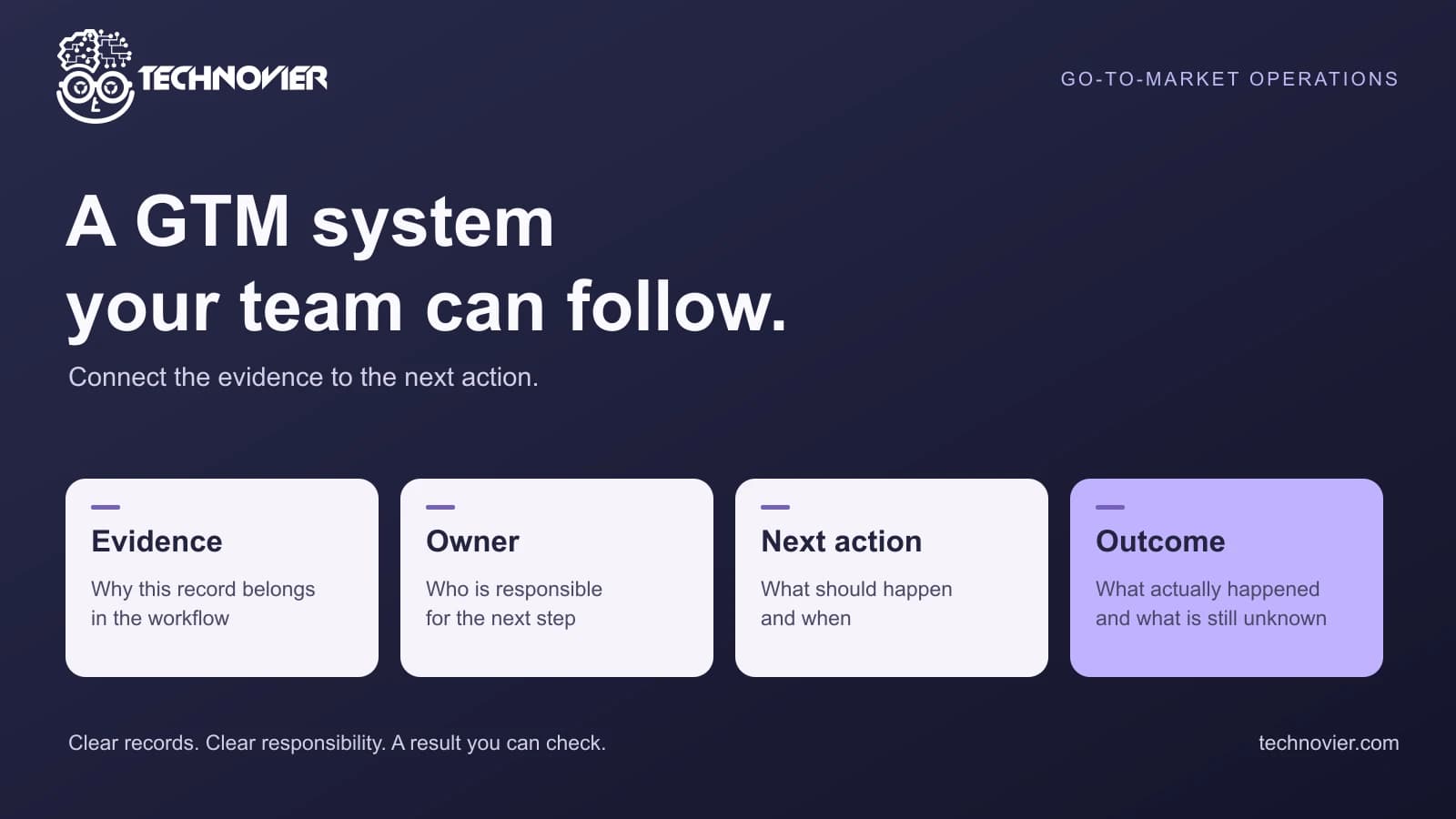
That is a useful starting point for building a GTM system. The system needs to connect the work of finding an audience, starting a conversation, qualifying interest, and moving a suitable opportunity forward. Each handoff needs a record that the next person can understand.
At Technovier, our lead-to-revenue approach connects acquisition, qualification, response, CRM, booking, follow-up, and reporting. The practical question is how much of that connection a particular business needs, and which gap deserves attention first. A focused repair may be enough. A wider build makes sense when several connected workflows need to change together.
The framework below draws on our published work on research quality, attribution, enrichment, and email measurement. It offers a way to decide what to build and what to verify, without treating software activity as a business result.
Define the outcome before designing the workflow
Start with the decision the business needs to make. A founder reviewing a campaign might need to know whether it is reaching the intended buyers. A sales lead might need to know which qualified inquiries have no next action. An operations team might need to know why a booked appointment did not happen.
Those are different questions. A single “lead” or “completed” status cannot answer all of them.
Keep the milestones that matter to your workflow distinct. A candidate found through research is not automatically a reviewed contact. A reviewed contact is not automatically eligible for a campaign. A submitted message is not a reply. A booked meeting is not an attended meeting, and attendance is not a sale.
Our enrichment review makes the first distinction concrete: completing a research task, validating a field, saving it, and allowing it into a campaign are separate decisions. Combining them into one success counter hides where the work remains unfinished.
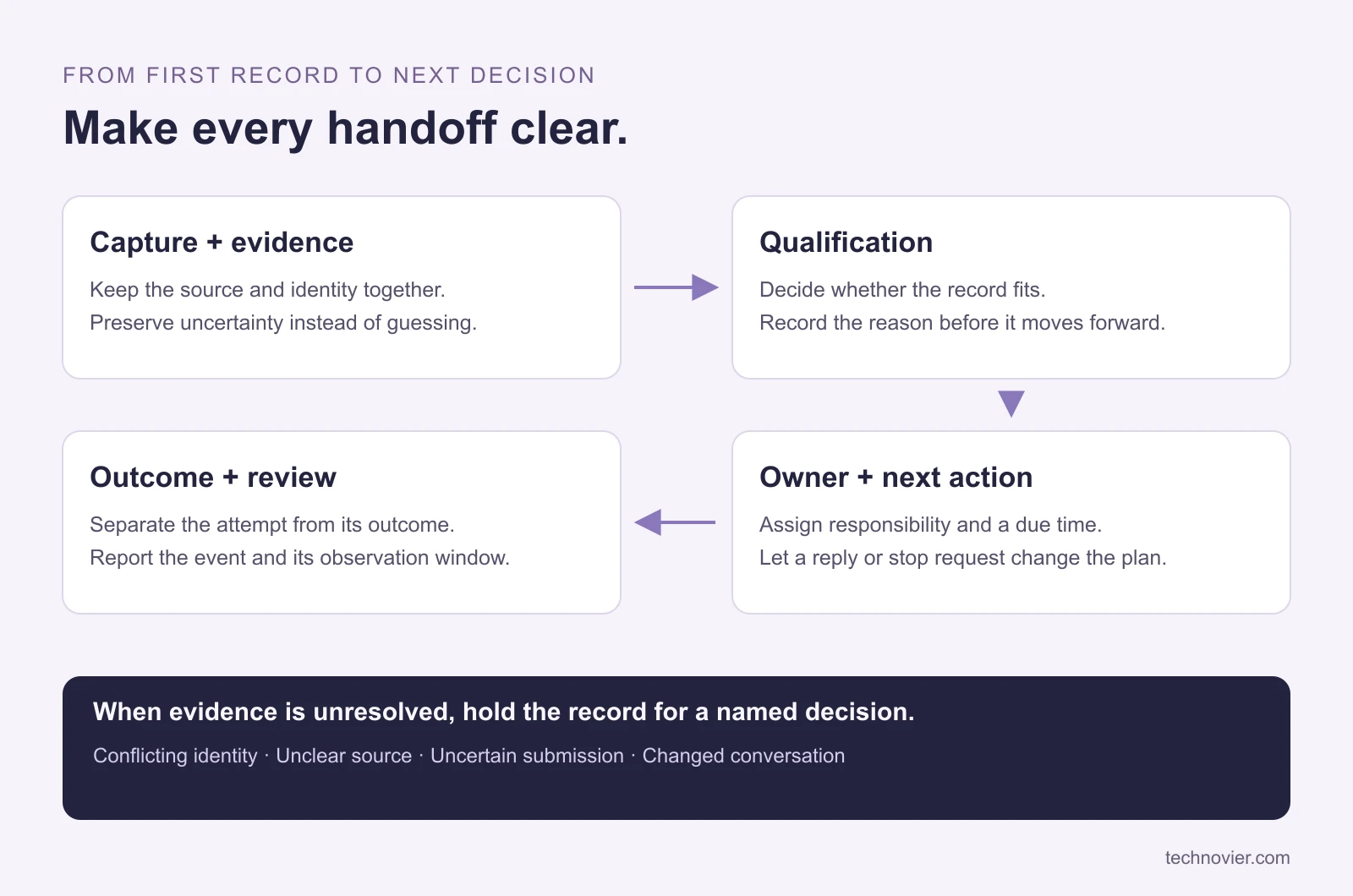
Write down what must be true before a record moves forward. Keep the rule short enough that the person doing the work can apply it.
| Handoff | What the next person needs | What to verify |
|---|---|---|
| Research to a contact record | The intended company or person, source evidence, and unresolved conflicts | The evidence belongs to the right identity |
| Capture to qualification | The inquiry, acquisition path, and relevant fit information | The fields reached the record without a silent change |
| Qualification to follow-up | A decision, an owner, and a dated next action | Someone can act on the record |
| Follow-up to booking | The actual response and appointment state | A click or acknowledgement was not counted as a booking |
| Booking to reporting | Attendance, opportunity stage, and the observation window | The report describes the event that actually occurred |
Use the rows that apply to your business. The purpose is to make the next handoff usable, rather than to create more administration.
Keep the reason for a decision attached to the record
A contact record is easier to trust when another person can see why it exists and why it belongs in the intended audience.
In a bounded Technovier comparison of search and crawling, targeted search produced more campaign-ready contacts after review in that sample. Crawling still helped surface first-party material. The useful comparison concerned the reviewed result, not simply the quantity of pages collected.
That distinction changes the design question. Instead of asking only how many records a tool can produce, ask what a reviewer needs to accept, reject, or hold each record.
For an outbound record, that might include the company match, the role evidence, the contact channel, and the reason it fits the offer. For an inbound inquiry, it might include the original request, the captured source, and the qualification information the team actually uses. Keep uncertain fields distinguishable from checked facts.
The same principle applies to attribution. A generic CRM source label does not establish an ad-level match. Our Meta-to-GoHighLevel attribution guide separates verified ad matches, campaign-level matches, inferred hints, and unknown records. Preserving those distinctions makes the report more useful when someone asks what its labels can support.
More fields are not automatically better. Add a field when it changes a decision, supports a handoff, or explains an outcome. If nobody uses or maintains it, reconsider whether it belongs in the everyday workflow.
Give follow-up an owner, a next action, and a stop rule
An automated acknowledgement can tell a prospect that an inquiry arrived. It does not establish that a person reviewed the request or that a useful conversation happened.
For each qualified inquiry, a practical workflow should make three things visible:
- Ownership: the person or queue responsible for the next step.
- Next action: what should happen and when it is due.
- Transition rule: what changes the plan, including a reply, booking, disqualification, or request to stop.
This is also where campaign design and team operations meet. Before increasing volume, check whether the team can review the incoming records, respond appropriately, and offer the intended next step. An unavailable calendar or an unowned task needs a different response from weak audience fit.
Treat those as questions to investigate. A low meeting rate alone does not prove that the team replied too slowly, that the targeting was wrong, or that the calendar was the constraint.
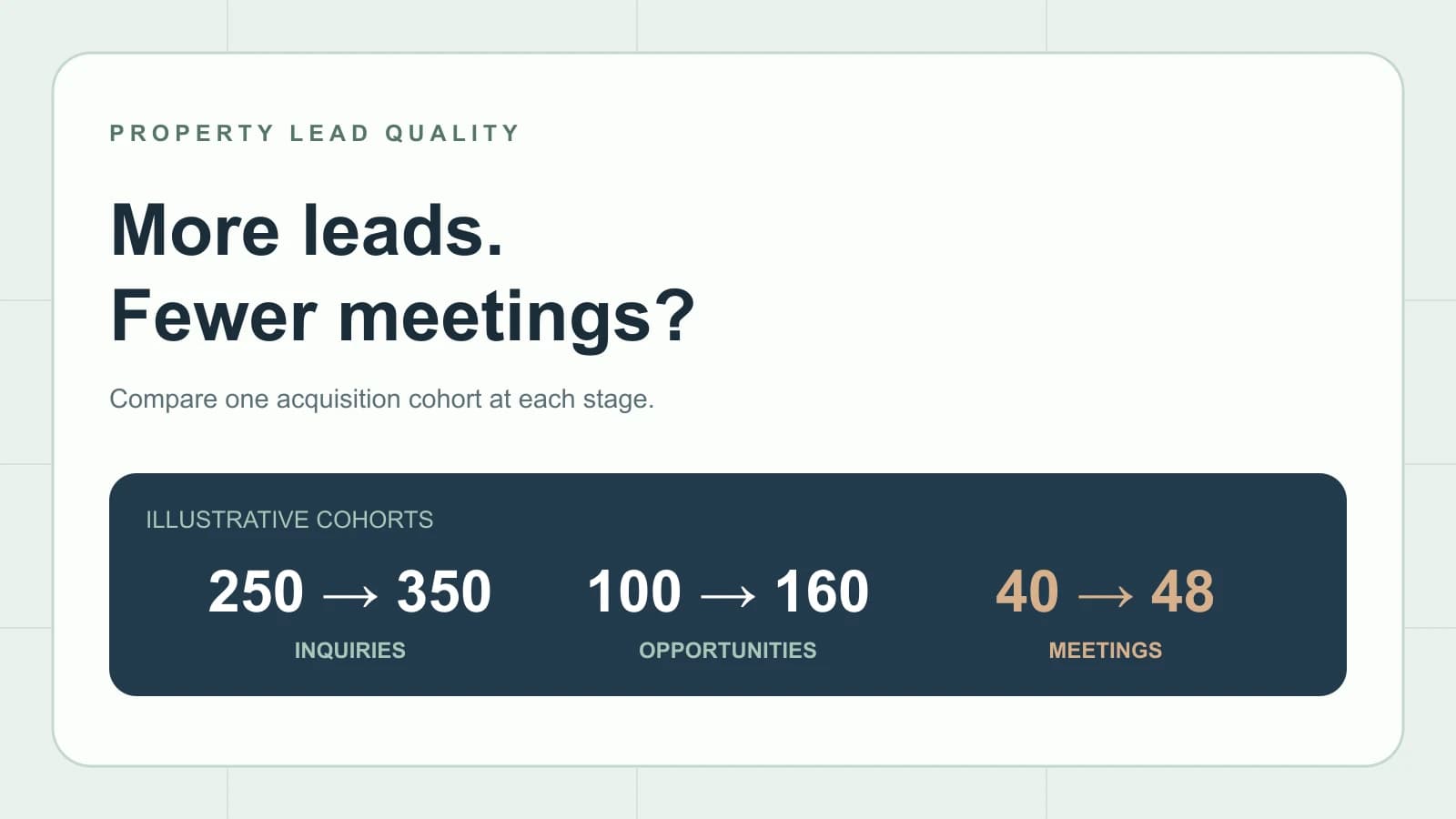
Our guide to property leads and qualified meetings explains why the same cohort needs to be followed through consistent stages and observation windows. Its worked numbers are synthetic; the useful lesson is the method for investigating progression.
Make the dashboard explain its numbers
A report should help someone decide what to do next. That requires knowing what each number represents.
A stored event row, a distinct event, and a person taking an action are different units. Our guide to duplicate email-open events distinguishes repeated processing from automated fetching. Removing repeated processing can fix a counter without establishing how many people read an email.
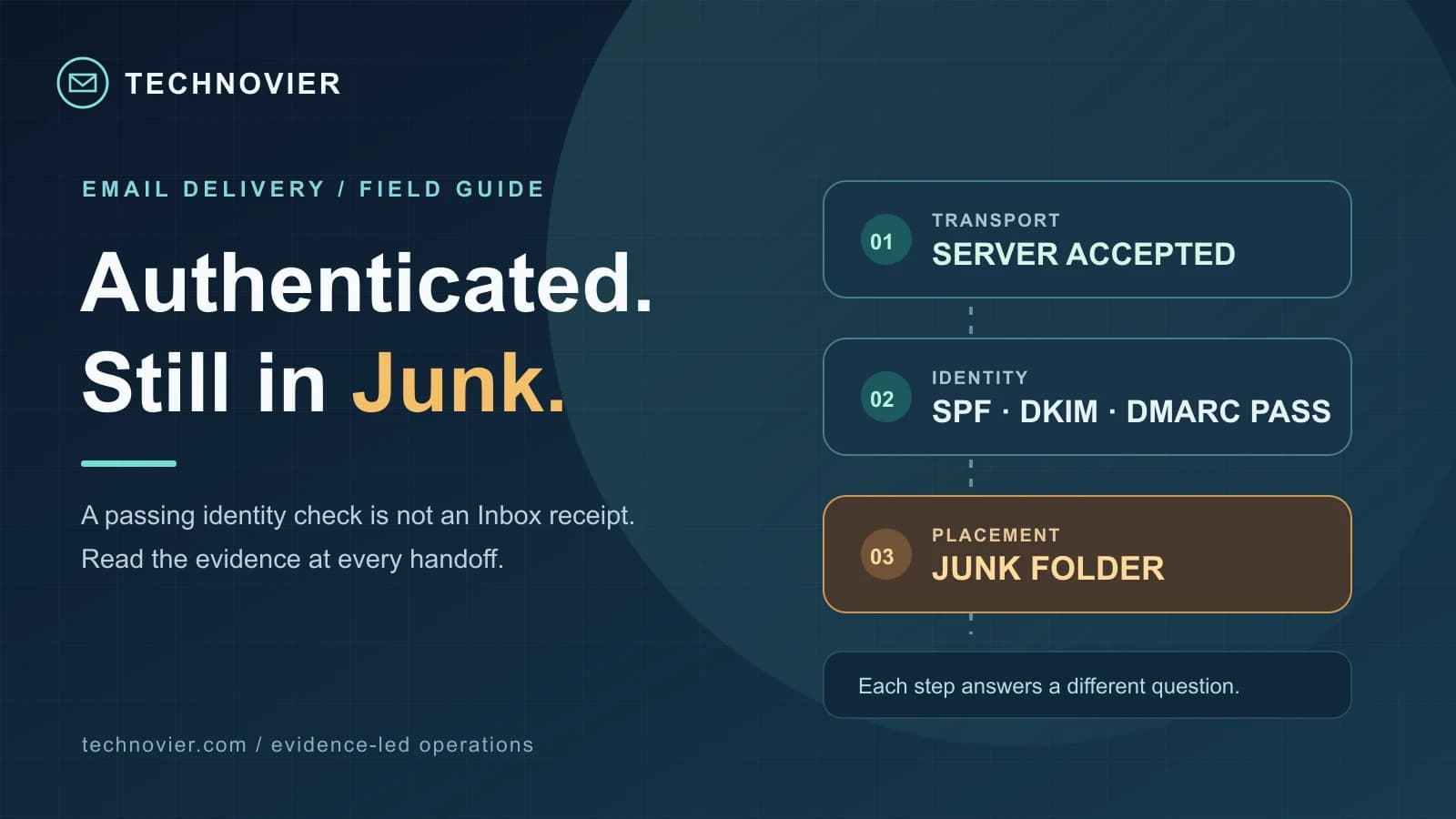
The same care is needed when a sending tool says “delivered.” In one review of authenticated email reaching Junk, a received control message passed authentication and was observed in Junk. A separate SMTP acceptance receipt belonged to another message. Joining the two into one success story would have exceeded the evidence.
For a founder, these details matter because the label influences the next investment. If an event count is being mistaken for interest, the team may optimize against the wrong signal. If a newer lead cohort has had less time to book, a comparison may punish it for being newer.
Put the definition beside the metric:
| Metric | Definition to make explicit | Question it still leaves open |
|---|---|---|
| Qualified opportunities | The qualification rule, counted records, and period | Whether they received the intended follow-up |
| Attributed inquiries | The matching evidence and which records remain unknown | Whether the campaign caused the outcome |
| Recorded opens | The event unit, repeat handling, and automation classification | Whether a person read the message |
| Booked meetings | The appointment event, cancellations, and reporting window | Whether the meeting happened |
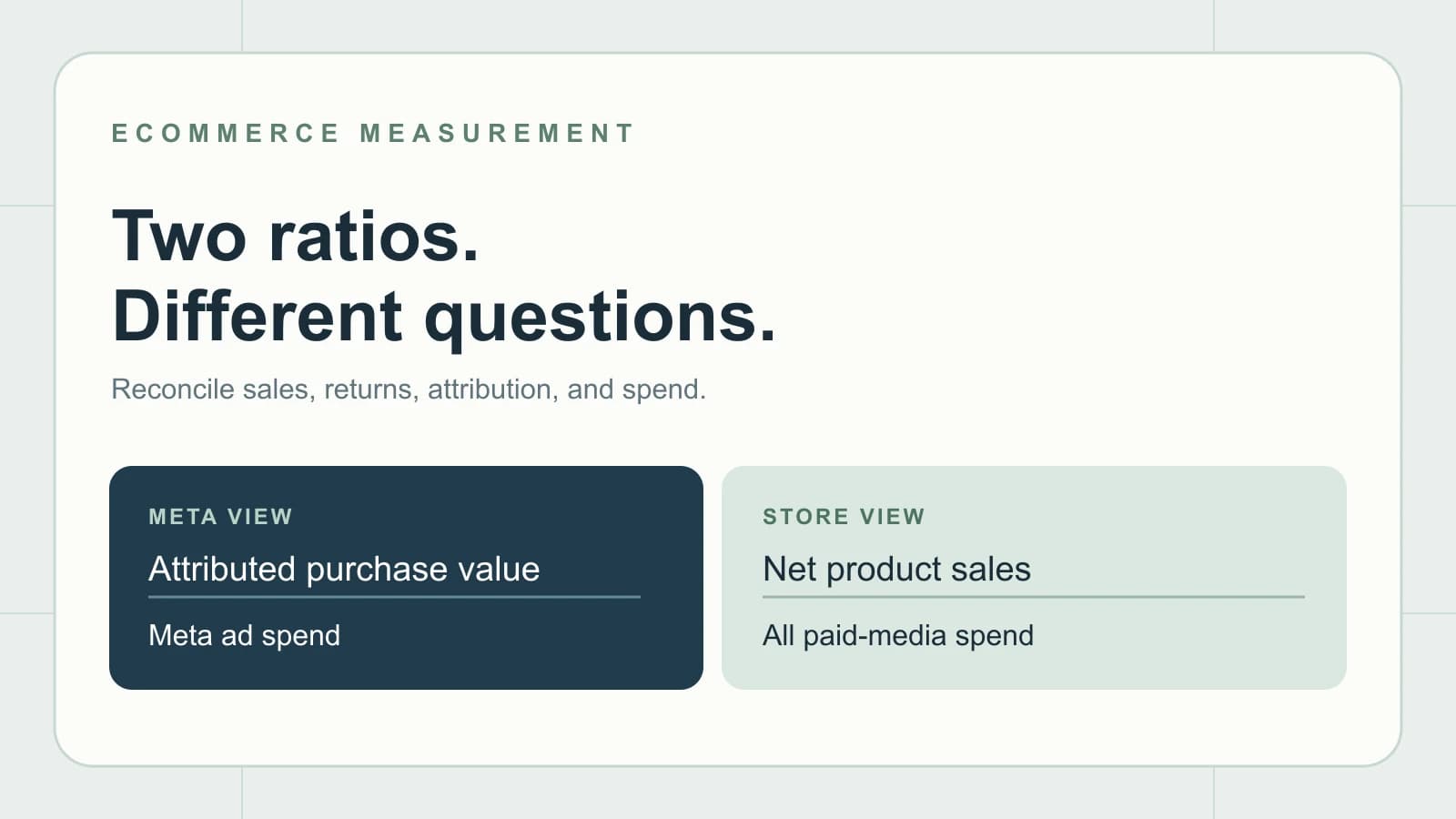
| Sales-to-spend ratio | The sales definition, spend scope, and period | Whether the activity was profitable or incremental |
A visible “unknown” category is often more useful than a confident classification that cannot be reconstructed. The report can stay simple while retaining the underlying evidence needed to investigate a result.
Choose the smallest build that addresses the demonstrated gap
Building a GTM system does not require replacing every tool at once. Existing CRM, scheduling, messaging, and analytics products may already cover much of the workflow. The task is to establish what is missing, then decide whether configuration, integration, or custom development is justified.
A useful scope statement has four parts: the observed gap, the affected records, the proposed change, and the result that will be checked.
For example, if a form submission contains a campaign identifier but its CRM record does not, inspect the intake mapping. If the CRM retains the identifier but the report loses it, inspect the reporting join. If the record is qualified but has no next action, inspect ownership and workflow rules.
These are different repairs. Buying another reporting tool will not, by itself, assign an owner. Rewriting a landing page will not, by itself, reconcile duplicated events.
Custom development can be appropriate when an important workflow cannot be expressed reliably in the existing tools. It also introduces maintenance, testing, and ownership obligations. Decide who will maintain the connection and investigate failures before making it central to the business.
The goal is a bounded improvement that can be checked against the problem it was intended to solve. Expand the scope when evidence shows that the constraint crosses several systems.
Decide where automation should wait
Automation works better when the workflow has an explicit place for uncertainty.
The published enrichment review described identity conflicts that kept candidates unresolved. A company channel also could not simply be promoted into a named person's direct contact detail. Those are decisions that a completed-task label should not erase.
The same discipline applies after an action starts. If a submission times out after the provider may have accepted it, reconcile the result before sending again. If a reply changes the conversation, update the next step before allowing an older sequence to continue.
A hold needs an owner and a way to resolve it. Otherwise, the workflow merely moves uncertainty into a forgotten queue.
This creates a practical tradeoff: a campaign may advance more slowly while records are reviewed, but the team can explain who entered it and why. The right balance depends on the audience, channel, and consequences of an incorrect action. No single automation setting removes that judgment.
Walk one opportunity through the system
Before commissioning a wider build, take one recent opportunity and follow its record from entry to its current stage. Use a record the team is authorized to inspect, and keep personal details out of presentation material.
- Can you explain why the inquiry or researched contact fits the intended audience?
- Can you trace its acquisition source and distinguish verified information from an inference?
- Did the correct record reach the CRM without an unexplained duplicate?
- Is a person or queue responsible for the next action?
- Is the action due at a meaningful time, and is the intended next step available?
- Does a reply, booking, disqualification, or stop request change the workflow?
- Can you distinguish the contact attempt from the reply, meeting, or sale it was intended to produce?
- Does the report use the same stage definitions and observation window as the underlying records?
An answer that cannot be reconstructed is a candidate for investigation. It is not yet proof of lost revenue or a reason to replace the whole stack.
Choose the next improvement from that investigation. Record what changed, read back the affected handoff, and check the result before expanding the workflow.
If your team needs help connecting these steps, explore Technovier's lead-to-revenue systems. The starting point is the constraint your business can demonstrate and the smallest scope that can address it.
FAQ
What does building a GTM system actually involve?
It involves agreeing how audience research or inbound capture connects to qualification, ownership, follow-up, customer records, and reporting. Software supports those connections; the team still needs definitions for the decisions and outcomes.
Do we need a new CRM to improve our GTM workflow?
Not necessarily. Start by checking whether the existing CRM can support the required fields, ownership, stage history, and integrations. A configuration repair may be sufficient. A replacement deserves a clear reason and a migration plan.
Which metric should a founder review first?
Start with the business question. If the concern is qualified conversations, examine qualified opportunities and their progression to meetings using a consistent cohort and window. Activity measures can help diagnose a gap, but they do not establish a downstream result.
How much data should a contact record contain?
Enough to support the next decision and explain how the record reached its current state. Prioritize useful source evidence, qualification, ownership, next action, and outcomes. Avoid adding fields that the team cannot maintain.
How should a small team decide what to automate?
Choose a recurring handoff with a clear rule, owner, and verifiable result. Define how the workflow handles uncertainty, changed conversations, and stop requests. Verify a bounded implementation before increasing its scope or volume.