Meta lead attribution in GoHighLevel can be incomplete even when a lead clearly arrives from a Meta campaign. The contact may have no usable ad ID. A contact's source label may say “Facebook,” while the campaign or ad that produced the lead remains unverified. If that contact later books a call, a report can repeat the source label without gaining any new evidence about the original ad.
The practical fix starts with a narrower question: what evidence survived each handoff from Meta to the contact record, then to the booking or opportunity, then to the report? Treat an ad ID, a campaign ID, and a source hint as different levels of certainty. Do not turn a missing identifier into an invented match.
GoHighLevel documents first and latest attribution and exposes attribution objects in its advanced contact search API. The fields available on a particular record depend on how the lead entered, what was passed at submission, and the account's setup. A visible source label alone does not establish an ad-level match.
Where the trail can break
Start by separating two common lead paths:
- Website form after an ad click. The visitor lands on a tagged URL, navigates, and submits a form. Check whether the landing page, form, and contact record retained the relevant UTM values and any ad identifiers. GoHighLevel's Meta ads UTM setup guide describes the URL-tagging and reporting setup. A tag on the first URL does not prove that it reached the form submission.
- Meta instant lead form. The person submits inside Meta rather than on your website. There may be no website visit carrying your landing-page UTMs. Inspect the data provided by the connected lead-form integration and what was stored on the resulting contact. Do not diagnose every instant-form gap as a missing website UTM.
After intake, compare the original contact record with later booking, opportunity, and reporting records. The identifier might never have arrived, might exist on the contact but be absent from the reporting join, or might have changed during a later update. These are different problems and call for different checks.

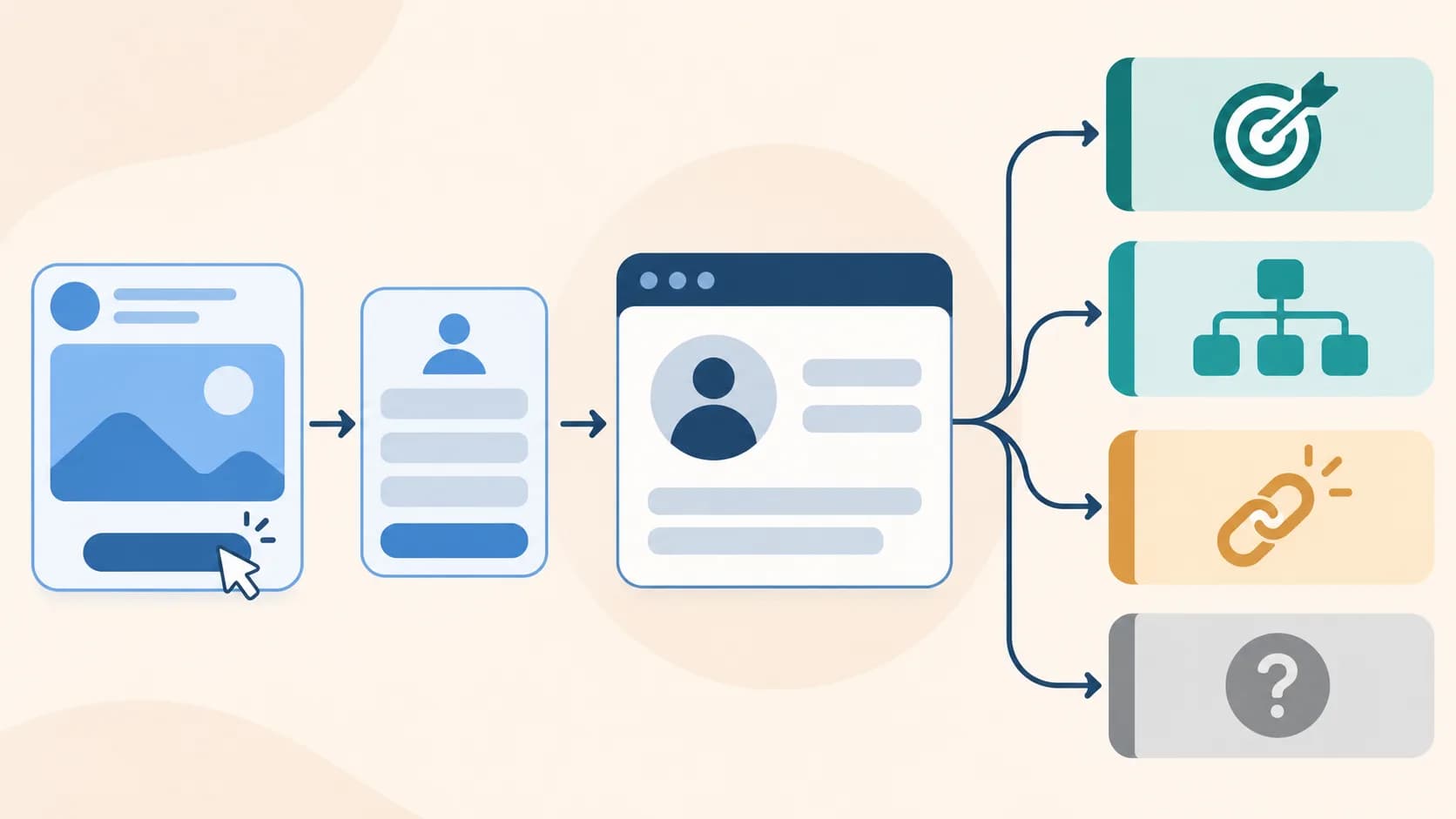
Conceptual illustration. The fading token represents a possible loss of evidence at a handoff; it is not a screenshot of a customer system.
An evidence ladder for each lead
Classify the available evidence before calculating coverage. The table is a decision aid, not a claim that every GoHighLevel account exposes identical fields.
| Level | What you can verify | What you can say | What you cannot say yet |
|---|---|---|---|
| Ad-level match | A captured ad ID matches an ad in the relevant Meta account and period. | This lead is linked to that ad. | That the ad alone caused the later sale. |
| Campaign-only match | A captured campaign ID matches a campaign, but no usable ad ID is present. | This lead is linked at campaign level. | Which individual ad produced it. |
| Inferred hint | A source label, referrer, or name suggests Meta, without a verified ID match. | Meta is a plausible source requiring review. | That a specific campaign or ad is confirmed. |
| Unknown | No usable source or matching identifier survives. | Attribution is unresolved. | That the lead came from Meta. |
Keep “inferred” separate from “exact.” An ad name may change or repeat; a source label can be broad. If the identifier is absent, a reasonable guess is still a guess. Also keep first and latest touch distinct: a later visit can add context without replacing the evidence for the first recorded touch.
A read-only audit you can repeat
- Define a period and denominator. For example, take contacts created from a specific Meta lead path during a stated date range. Count all eligible contacts before calculating how many have a verified ad ID. Exclude test and duplicate records only under a written rule, and report the exclusions.
- Trace one record across systems. Record the Meta form or tagged landing URL, the submission time, the contact creation time, the stored first and latest attribution, and any booking or opportunity linked to the contact. Compare IDs against the relevant Meta account and time period.
- Find the first missing step. If the submission carried an ID but the contact did not, inspect intake mapping. If the contact has it but a downstream report does not, inspect the report's source and join. If no ID was supplied at intake, repairing a report cannot recreate proof of that ad.
- Split coverage by path. Report website forms and instant forms separately. If useful, split by form, campaign, or integration version. A combined percentage can hide a weak path.
- Record uncertainty. Count ad-level, campaign-only, inferred, and unknown records separately. Keep the underlying record IDs and timestamps available for review, but remove personal data from shared summaries.
This review should begin with read-only exports or API access. Editing contact sources to make a dashboard look complete destroys the very evidence needed to diagnose the gap. For a broader view of handoffs beyond attribution, see lead-to-revenue systems, lead generation, and marketing solutions.
What the coverage number means
A useful first measure is verified ad-ID coverage = eligible contacts with a validated ad-ID match ÷ all eligible contacts in the defined cohort. Give the numerator, denominator, period, and inclusion rules with the percentage. Calculate campaign-only coverage separately. Do not count inferred hints as verified ad-level matches.
That coverage measure describes the completeness of one evidence field. It does not establish lead quality, incremental lift, return on ad spend, or whether Meta received credit for a sale. Those questions need separate outcome data, cost data, identity matching, and attribution rules. Our lead generation ROI calculator can help structure a financial scenario, but its outputs depend on the inputs and should not substitute for verified campaign reporting.
What to change after you locate the gap
For website forms, test the actual ad URL through submission and confirm which parameters survive in the contact record. For instant forms, test a lead through the connected integration and inspect the fields it supplies. Where a stable identifier is available, preserve its original value and document which field stores it. When downstream reports are built, make the join to the contact and the chosen first or latest touch explicit.
Run a new test after each mapping or workflow change. Compare the new record with the earlier failing example and note which evidence level it reaches. Keep historical gaps labeled as unresolved unless independent records provide a verifiable match. A cleaner future capture path does not retroactively prove the source of older leads.
FAQ
Why does a GoHighLevel contact say Facebook but have no ad ID?
“Facebook” may be a broad source label. It does not guarantee that an ad identifier was captured or retained. Check the entry path, the original submission or integration payload, and the stored contact attribution before treating it as an ad-level match.
Should I add UTMs to every Meta instant lead form?
Website URL UTMs apply to visits through tagged links. An instant form is submitted inside Meta, so inspect the integration's lead data and field mapping for that path. Test the actual form and contact record rather than assuming a website URL tag will appear there.
Can a campaign ID recover a missing ad ID?
A verified campaign ID supports campaign-level reporting. It does not identify the individual ad. Keep the lead in the campaign-only group unless another reliable record supplies and verifies the ad ID.
Can I backfill old contacts from ad names or source labels?
You can flag plausible matches for review, but label them inferred. Do not present a name match or broad source label as a verified ad-ID match. Preserve the original record and document any later annotation.
Does a missing ad ID mean the lead was not from Meta?
No. It means the available record does not support an ad-level match. Review the original submission or integration data and any independent, verifiable identifiers before deciding how to classify the lead.