What is Business Automation?
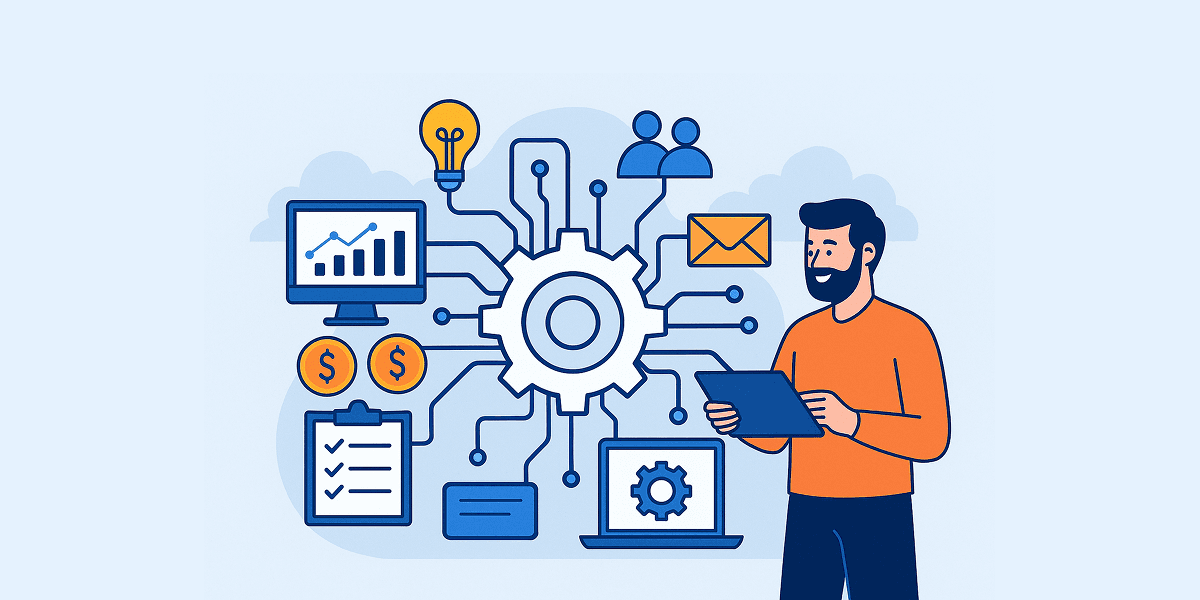
Business automation is the use of digital technology to carry out recurring processes in a company where manual effort can be minimized. It allows organizations to streamline operations, save costs, improve accuracy, and enhance overall productivity. With the rise of advanced technologies like AI, machine learning, and robotic process automation (RPA), the business automation landscape in 2025 has become more accessible and powerful than ever before.
Many industries—such as real estate ecommerce, and solar—are actively adopting automation to improve service delivery, reduce costs, and gain a competitive edge. The rise of specialized automation for education consultants and healthcare businesses further illustrates how this technology is transforming industry operations.
Why Business Automation Matters in 2025
As businesses adapt to a post-pandemic economy, the need for efficiency, speed, and remote-friendly solutions has intensified. Business automation addresses these pressures through:
-
- Consistent and accurate task execution
- Real-time data processing
- Enhanced decision-making with analytics
- Better resource allocation
- Streamlined communication and collaboration
More importantly, automation creates a sustainable growth strategy. Teams can do more with less, reduce burnout, and respond faster to changes in demand—all while improving customer satisfaction.
Key Benefits of Business Automation
1. Boosted Productivity
Employees spend less time on repetitive tasks and more on value-generating work. For instance, AI chatbots can resolve FAQs, manage bookings, and escalate tickets automatically. In this blog, we covered how businesses automate 70%+ of customer service requests with AI.
2. Cost Efficiency
Fewer manual errors and faster processing times lead to direct savings. Businesses that implemented Technovier’s automation services saw a 30–50% reduction in operational costs within six months. Automated finance tools also support functions like invoice processing and payroll without extra headcount.
3. Error-Free Execution
Unlike humans, automated systems don’t fatigue or skip steps. This results in more reliable reporting, invoicing, and compliance management. Content automation tools even ensure accuracy in copy generation and marketing output.
4. Enhanced Customer Experience
Automation tools create faster, personalized experiences. Automated workflows like lead nurturing CRMs respond instantly to prospect actions, improving conversion rates. For instance, an eCommerce client using automated product suggestions boosted revenue per visitor by 22%.
5. Better Compliance & Documentation
Systems can auto-log actions and maintain consistent audit trails, helping companies remain compliant with data privacy and regulatory standards. Especially in industries like healthcare, this feature is vital to meet HIPAA/GDPR requirements.
Types of Business Automation in 2025
- Robotic Process Automation (RPA): Automates repetitive rule-based tasks like data entry and document filing.
- Intelligent Automation: Uses AI and machine learning to improve over time and make decisions independently.
- Workflow Automation: Automates task handoffs between departments using software.
- Process Mining: Detects workflow inefficiencies using digital footprints.
- Business Process Management (BPM): Manages and optimizes end-to-end processes for long-term gains.
Top Business Automation Tools in 2025
- Zapier: A workflow tool that connects 6,000+ apps to automate day-to-day tasks
- UiPath: Ideal for RPA in finance, HR, and back-office operations
- HubSpot: Offers a unified platform for CRM, sales, and marketing automation
- Make (Integromat): Great for complex data routing and integrations
- Technovier CRM: Custom-built CRM with embedded automation for workflows and reporting
Top 10 Use Cases with Real Examples
- Customer Service: Chatbots resolve inquiries 24/7 and reduce human workload.
- Sales: Technovier CRM automates lead assignment and follow-ups, improving conversions.
- Marketing: Meta marketing solutions automate customer segmentation and ad delivery.
- Finance: Automation improves invoice tracking, budgeting, and reconciliation.
- HR: Automates hiring, onboarding, payroll, and benefits management.
- IT: Incident responses and updates managed through automation agents.
- Ecommerce: Tools for personalized offers and order fulfillment.
- Healthcare: Automates scheduling, reminders, and record updates.
- Real Estate: Campaigns drive and convert leads efficiently.
- Solar Sector: CRM reduced lead response time by 80%.
Core Benefits of Business Automation
- Reduced Cost: Save on labor and operations.
- Faster Execution: Speed up workflows.
- Improved Accuracy: Reduce human error.
- Enhanced Experience: Deliver faster, smarter customer service.
- Informed Decisions: Real-time data for better planning.
Technovier vs IBM Comparison
| Feature | IBM Cloud Pak | Technovier |
|---|---|---|
| AI Chatbot | ✔️ | ✔️ Customizable |
| CRM Built-in | ❌ | ✔️ Fully Integrated |
| Price | Enterprise Only | Flexible Plans |
| Case Studies | Generic | Niche Specific |
Implementation Strategy
- Audit your existing workflows.
- Select tools that align with your needs (e.g., Technovier CRM).
- Start with one pilot process.
- Train your staff and gather feedback.
- Measure KPIs and optimize.
Trends to Watch
- Hyperautomation
- Autonomous AI agents
- Low-code workflow builders
- Voice-triggered workflows
- Real-time AI decisioning
Real-World Automation Success Stories
- Amazon: Uses AI-driven robots in warehouses to speed up picking and fulfillment
- PayPal: Leverages AI to scan millions of transactions for fraud detection in real time
- Netflix: Uses machine learning to personalize content recommendations and automate media delivery
- Solar CRM Project: Our client’s campaign resulted in 3x faster lead responses and 40% increase in conversions
- Study Abroad Consultancy: Implemented automated lead funnels using chatbots, email triggers, and CRM updates
How to Start with Business Automation
- Audit repetitive workflows across marketing, sales, finance, and HR
- Choose scalable automation platforms that integrate well (e.g., Technovier CRM)
- Define KPIs and automation goals with clear outcomes
- Pilot one department, gather feedback, and refine your workflows
- Train your team to embrace automation culture and leverage performance data

We help clients implement this entire roadmap through tailored workshops and discovery calls. Get started here.
Automation Trends to Watch in 2025
- Autonomous Agents: AI systems that independently complete multi-step actions with context
- Hyperautomation: Combining AI, ML, and RPA for intelligent automation that continuously improves
- Voice-Driven Automation: Use voice assistants to trigger workflows or retrieve business data
- Real-Time CRM Triggers: Automated pipelines that personalize customer interactions based on behavior
- Low-Code/No-Code Interfaces: Let non-developers deploy automated solutions using drag-and-drop interfaces
Conclusion
Business automation is no longer an emerging concept — it’s a critical business strategy. From startups to global corporations, companies are using automation to grow smarter, serve faster, and scale sustainably.
With the right roadmap and partners, like Technovier, your business can harness automation to unlock operational excellence and future-proof growth. We invite you to explore our case studies and learn how automation is transforming businesses just like yours.
Ready to automate the smart way? Talk to us today and let’s design a roadmap tailored to your unique business needs.