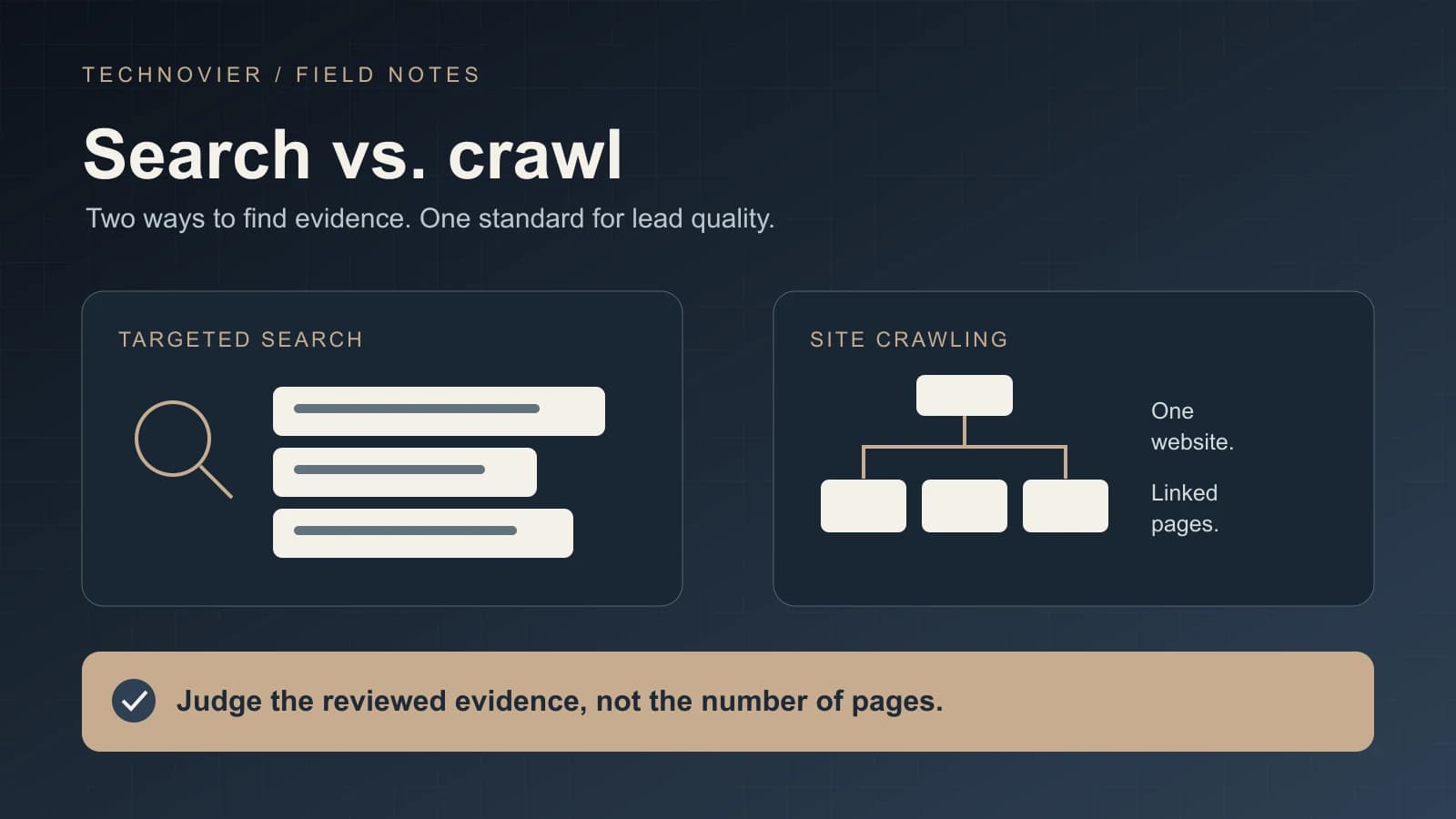
Finding a company's website is not the same as finding enough reliable evidence to decide whether a contact belongs in a campaign. That distinction matters when AI helps with lead research: a system can collect plenty of pages while leaving the final decision uncertain.
We compared targeted web search with crawling pages on already known company websites in a bounded internal lead research exercise. After human review, targeted search produced more campaign-ready contacts in this sample. Site crawling still helped surface first-party pages. The result is directional; it does not establish that one method is best for every market, website, or research question.
What each method can contribute
Targeted search can find relevant information across the wider web. It is useful when the company website is incomplete or the research question needs context from elsewhere. A site crawl stays within a known website and can uncover pages that a researcher might otherwise miss.
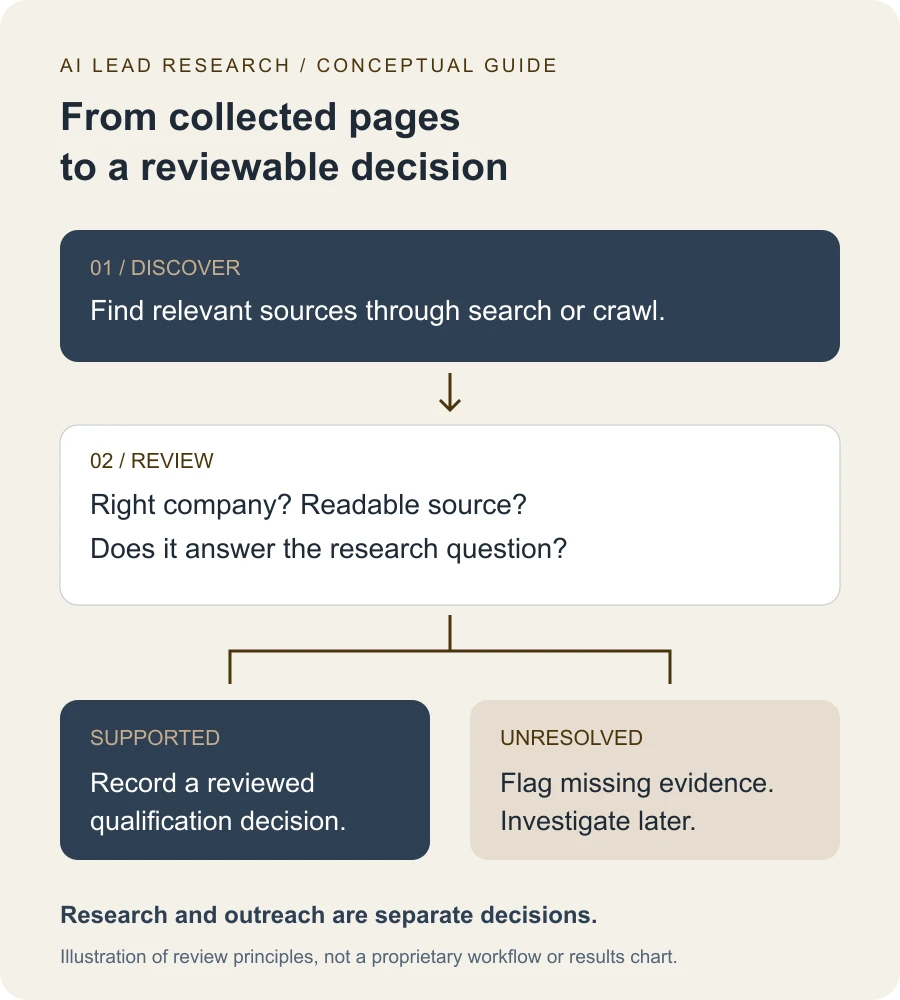
Neither method turns a page into a trustworthy lead by itself. The useful outcome is a decision that a person can verify against readable evidence and the right company. A blocked page, an unrelated organization, or a confident summary without a usable source should not count as a successful qualification.
Targeted search vs site crawling at a glance
The comparison below describes the scope of each approach. It is not a performance ranking.
| Question | Targeted search | Site crawling |
|---|---|---|
| Where does it look? | Across web results relevant to a query. | Within an already known company website. |
| What can it contribute? | Wider context and sources beyond the company site. | First-party pages and linked information on that site. |
| What can limit it? | Results may refer to the wrong company or lack usable evidence. | Pages may be blocked, incomplete, or irrelevant to the question. |
| What still needs review? | Source relevance, company match, and support for the decision. | Source relevance, company match, and support for the decision. |
Measure the decision, not the activity
For a practical comparison, count the contacts that remain usable after review. Pages discovered, pages fetched, and AI responses are activity measures. They can explain workload, but they do not prove that a contact is ready for outreach.
The same principle applies to a wider lead-to-revenue system. Research is valuable when its evidence reaches the people responsible for qualification and follow-up. Our article on the hidden cost of fragmented GTM explains what happens when context is lost between those steps.
Keep a human check at the handoff
In our comparison, manual review changed how some apparent successes should be counted. That is a useful reminder that research outputs need a check before they become campaign actions. The reviewer should be able to see the source, confirm that it belongs to the intended company, and decide whether it answers the actual question.
This is especially important for AI-assisted workflows. The model can help organize evidence, but it should not turn incomplete or mismatched material into a confident assertion. If a source cannot be verified, the right outcome is an unresolved record that can be investigated later.
What to do next
If your team is evaluating research methods, run a small, clearly scoped comparison using the same definition of a usable lead for both methods. Review the resulting decisions, record failures, and repeat the test before making a wider claim. Keep research and outreach as separate decisions.
For related reading, see what a revenue systems audit finds and how to stop lead leakage after ads. If the research-to-follow-up handoff is the problem in your own process, talk to Technovier about the system around it.


