"We need a CRM" is one of the most common things a growing service business says. It is also one of the most misdiagnosed.
Most teams that say it don't actually have a place-to-store-contacts problem. They have a leads-are-falling-through-the-cracks problem. A CRM alone rarely fixes that, which is why so many businesses buy one, import their contacts, and six months later admit it became an expensive address book.
The real question is not "which CRM." It is whether you need a system of record or a system of action.
What a CRM Actually Is
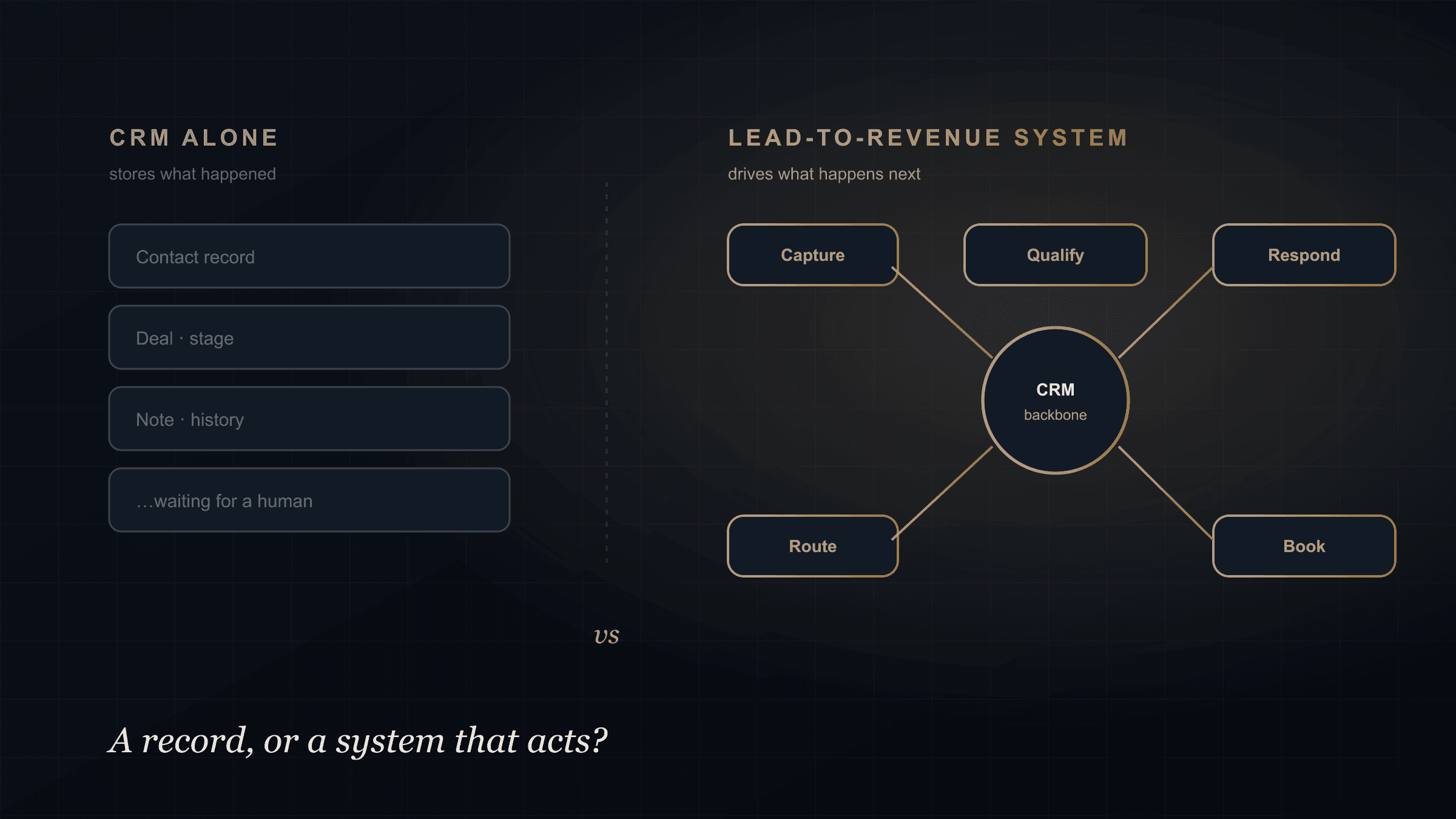
A CRM is a database of relationships. It stores contacts, companies, deals, and history. At its best, it gives you a single place to see who you're talking to and where each deal stands.
That is genuinely valuable. But notice what a CRM does not do on its own: it doesn't capture the lead the instant it arrives, respond to it, qualify it, route it to the right person, or follow up when someone goes quiet. It records those things after a human makes them happen.
A CRM is passive by design. It reflects the work; it doesn't do the work.
Why a CRM Alone Disappoints Service Businesses
Service businesses live and die on speed and follow-up. A CRM that only stores what already happened leaves the actual revenue-critical moments unmanaged.
The lead still waits hours for a first reply, because the CRM doesn't respond. The hot lead still gets missed, because the CRM doesn't route or alert. The follow-up still depends on someone remembering, because the CRM doesn't chase. And when leads live in the CRM but capture, enrichment, and follow-up happen in other tools, you get the exact fragmented GTM problem: tools that don't share context, and leads lost in the handoffs.
So the CRM fills up with records, the team keeps doing manual work around it, and the promised transformation never arrives. The tool wasn't wrong. It was the wrong scope.
What a Lead-to-Revenue System Is
A lead-to-revenue system is a system of action. It uses a CRM as its backbone, but it connects everything around it into one operating path: capture, enrichment, scoring, routing, follow-up, booking, and reporting.
The difference is what happens without a human prompting it. When a lead arrives, the system captures it, responds instantly, qualifies it, routes it to an owner, and follows up if they go quiet, all while keeping the CRM record current.
The CRM still stores the relationship. But now it sits inside a system that actually moves leads toward revenue instead of just recording where they stopped.
CRM vs Lead-to-Revenue System
| CRM alone | Lead-to-revenue system | |
|---|---|---|
| Stores contacts and deals | Yes | Yes |
| Captures leads instantly from ads and forms | Manual | Automatic |
| Responds within minutes | No | Yes |
| Qualifies and scores leads | Manual | Automated, with guardrails |
| Routes to the right owner | Manual | Automatic, with SLA |
| Follows up when a lead goes quiet | Manual | Automatic sequences |
| Books the meeting | Separate tool | Connected |
| Reports on speed-to-lead and source | Partial | End to end |
The CRM is a component. The lead-to-revenue system is the machine the component runs inside.
How to Tell Which One You Need
Ask what actually breaks in your funnel today.
If your problem is that nobody knows who's talking to whom, deals live in someone's head, and you have no single source of truth, a well-implemented CRM will help a lot.
If your problem is that leads wait too long, get missed, aren't followed up, or you can't see which sources convert, a CRM alone will not fix it. You need the system of action around it.
For most growing service businesses running paid ads, it's the second. The pain is speed and follow-up, not storage. A quick way to see the gap: the funnel leak calculator shows where leads drop out, and the speed-to-lead calculator estimates what slow response is costing.
You Don't Have to Choose Blindly
You don't need to guess which scope fits, and you don't need to rip out tools you already have. A lead-to-revenue system is usually built on the CRM and tools you already run, connected properly.
Technovier's CRM platform provides the backbone, and our CRM AI automation work turns it into a full lead-to-revenue system: instant capture, AI follow-up, routing, booking, and reporting connected end to end.
The honest way to decide is to look at where your leads actually leak first. Discuss your lead-to-revenue system and we'll map whether you need a CRM or the system around it.
FAQ
What is the difference between a CRM and a lead-to-revenue system?
A CRM stores contacts, deals, and history. A lead-to-revenue system uses a CRM as its backbone but connects capture, response, qualification, routing, follow-up, booking, and reporting into one operating path that acts on leads automatically. A CRM records the work; a lead-to-revenue system does it.
Do I need a CRM or a full system?
If your problem is a lack of a single source of truth, a CRM helps. If your problem is slow response, missed leads, weak follow-up, or no visibility into which sources convert, a CRM alone won't fix it and you need the system of action around it. Most service businesses running ads need the second.
Will a lead-to-revenue system replace my current CRM?
Usually not. It is typically built on the CRM and tools you already use, connected properly so context flows across them. You add architecture and automation rather than necessarily replacing your CRM.
How do I know where my leads are actually leaking?
Start by mapping the path from ad click to booked or closed, and measure response time and drop-off at each stage. Tools like a funnel leak calculator and a speed-to-lead calculator give a quick estimate, and a revenue systems audit maps it in detail before any build.