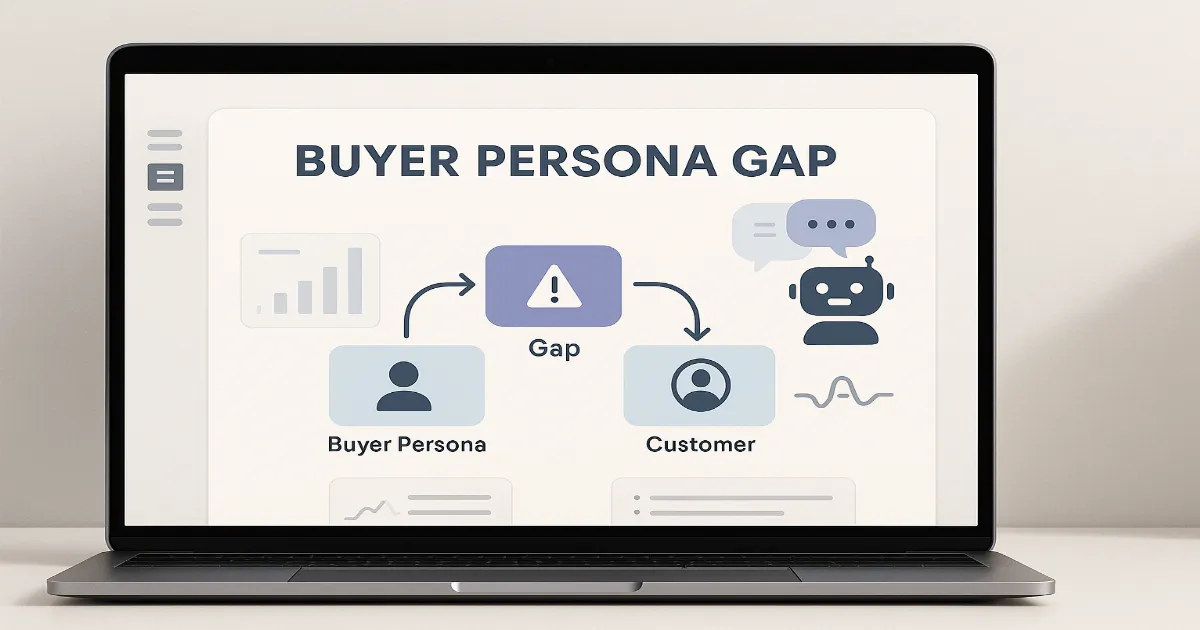
The Buyer Persona Gap That Quietly Drains Revenue
Buyer personas are meant to guide marketing, sales, and product decisions. They clarify who your customers are, how they think, and why they buy. Yet many organizations rely on personas that are generic, outdated, or built on assumptions instead of evidence. This gap doesn’t stay theoretical—it directly weakens acquisition, conversion, and retention.
When personas come from recycled templates rather than real behavior, campaigns feel misaligned. Messaging misses emotional triggers. Product teams solve the wrong problems. Over time, this creates silent friction across the entire growth engine.
Where Weak Personas Cause the Most Damage
- Marketing: Campaigns attract low-intent traffic because they speak to assumptions, not real buying motives.
- Sales: Lead quality drops as messaging attracts the wrong audiences into the funnel.
- Product: Feature priorities drift toward perceived needs instead of validated problems.
Why Most Personas End Up Flawed
Personas break down when they are built in isolation or frozen in time. Common causes include:
- Relying only on demographic data
- No direct input from sales or support teams
- Assumptions replacing behavioral evidence
- No review cycle as markets evolve
What Strong Buyer Personas Are Actually Built On
Effective personas are grounded in behavior, not theory. They are shaped using several consistent data sources:
- Sales call recordings and objection patterns
- Support tickets and churn reasons
- CRM pipeline movement and drop-off points
- Product usage and feature adoption trends
Cross-checking assumptions against these data points shifts personas from vague profiles into practical decision tools.
Segmentation That Supports Execution, Not Just Documentation
Strong segmentation focuses on meaningful differences—buying urgency, risk tolerance, operational pressure, and decision authority. More personas do not always mean better targeting. What matters is whether each persona drives a distinct strategy.
Why Personas Must Be Treated as Living Assets
Customer expectations shift with markets, regulations, and technology. A persona created two years ago can quietly become inaccurate without anyone noticing. The first signal is often declining campaign performance rather than a visible failure.
Teams that revisit personas quarterly stay aligned with real demand instead of historical assumptions.
Cross-Team Collaboration Is Not Optional
Marketing sees demand signals. Sales sees objections. Support sees friction after purchase. Product sees adoption gaps. When persona work excludes any of these groups, the result is always partial.
Shared ownership produces shared accountability.
Psychology and Outcomes Matter More Than Demographics
Age, income, and job titles rarely explain buying behavior on their own. What matters more is:
- What outcome the buyer is trying to reach
- What risk they fear most
- What internal pressure they face
- How they define success
These factors shape message timing, pricing sensitivity, and onboarding design far more than demographics ever will.
A Practical Way to Repair Weak Personas
Instead of rebuilding everything at once, start with one high-impact customer segment. Rebuild its persona using recent closed-won and closed-lost deals, customer interviews, and CRM lifecycle data.
Validate changes by testing messaging and product positioning inside that segment before scaling across the organization.
Final Perspective
Buyer personas are not branding exercises. They are operational instruments. When they reflect reality, teams move faster, waste less budget, and design solutions customers actually need. When they don’t, even strong execution struggles to produce consistent growth.
For organizations using advanced automation and behavioral modeling—such as those explored in our analysis of AI vs automation—accurate personas become even more critical, because systems only amplify the assumptions they are built on.